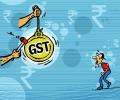
India needs Goods and Services Tax (GST) Council-like common platforms between states and the Centre in areas such as land clearances, power, and water to fast-track infrastructure projects to achieve double-digit growth going ahead, said Praveer Sinha, chief executive officer and managing director of The Tata Power Company.

India's consumer price index (CPI)-based retail inflation rate is likely to have cooled further in June, thus remaining below the 4 per cent target of the Reserve Bank of India (RBI) for a fifth consecutive month, giving the central bank wiggle room to focus on growth. Economists reckon that the decline is on account of easing prices in various categories of goods, especially food items, and a favourable base effect.
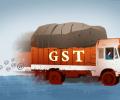
Of the two rate structures on the table, one suggests tax slabs of 8 per cent, 16 per cent, and 24 per cent. The other proposes tax slabs at 9 per cent, 18 per cent, and 27 per cent.

The Income-Tax (I-T) Department has detected widespread tax evasion involving cryptocurrencies and, according to media reports, has issued emails to thousands of defaulting taxpayers seeking transaction details. Investors must understand the tax rules governing crypto assets and respond promptly to these emails.

'The kids are already used to this place. We go back and that's a different environment.' 'So, mentally, emotionally we are stressed.'

Reserve Bank of India (RBI) Governor Sanjay Malhotra said the repo rate cut in the February meeting of the monetary policy committee (MPC) was due to inflation aligning with the target and recognising the fact that monetary policy is forward-looking.

The 31st meeting of the Goods and Services Tax (GST) Council, held in December 2018, deferred a decision to reduce the GST rate for cement from 28 per cent to 18 per cent. This was despite recognising that cement - along with automobile parts - remained among the few mass-consumption items still taxed at the highest slab, which was originally meant for luxury and sin goods.

rediffGURU T S Khurana answers readers' personal income tax queries.

'We have now drastically simplified it, primarily to two rates in long-term capital gains: 20% and the applicable rates. Similarly, in short-term capital gains.' 'For listed shares, there is a slight increase, but for unlisted shares, where indexation benefits are removed, there is a reduction in rates, benefiting unlisted companies, venture capital firms, etc.' 'Similarly, in real estate, wherever returns are higher, the new structure is beneficial. In very few cases, returns are lower, and those are more of an exception.'

'It's important for India to think about areas where it wants the US to move.' 'We can be far more innovative in what we ask the US.' 'Given that there's a package deal, why not do it?'

The more things change, the more they remain the same for corporate India. In the April-June 2025 period (Q1FY26) - for the ninth consecutive quarter - listed companies witnessed only single-digit revenue growth, while their core earnings, excluding other income and one-time gains, contracted for the second time in four quarters. This comes as firms brace for the impact of 50 per cent US tariff on Indian goods.

'Tax officials view most taxpayers as evaders.' 'The I-T department has a perverse incentive to raise unreasonable demands since the one-fifth tax collected counts towards officials' collection targets,' observes Harsh Roongta.

The choice of tax regime dictates how your income will be taxed. If you don't make the right pick, you might end up losing money.

To those who ask, "Is all this really worth it? Why can't domestic demand fill the gap?", it is important to remind them that only 13 economies since the Second World War have grown at 7 per cent or more for 25 years -- like India needs to. They all had one thing in common: Strong export growth underpinned by strong global engagement, explains Sajjid Z Chinoy.

Do you have financial planning or income tax queries? Ask rediffGURU Anil Rego.
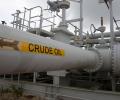
The government has slashed the windfall profit tax levied on domestically-produced crude oil as well as on export of diesel and ATF following a drop in global oil prices, according to an official order. The levy on crude oil produced by companies such as Oil and Natural Gas Corporation (ONGC) has been cut steeply to Rs 1,700 per tonne from Rs 4,900, the order dated December 15 said. Crude oil pumped out of the ground is refined and converted into fuel like petrol, diesel and aviation turbine fuel (ATF).

Many affluent young people are first-generation wealthy. They have limited financial literacy, lack quality financial guidance or role models, and often fall prey to mis-selling. This makes them hesitant to invest in high-return assets like equities.

The biggest risk for investors isn't the market, but their own minds, biases and emotions often lead to poor financial choices.

India has revised its proposal to impose retaliatory duties under the WTO (World Trade Organisation) norms against the US over American tariffs on steel and aluminium in view of the further hike in duty by the Trump administration. The US first imposed 25 per cent tariffs on imports of aluminium, steel and derivative articles on March 12.

Reliance Industries (RIL) annual general meeting (AGM) had several stunning announcements. RIL looks to list Jio Platforms (JPL) by June 2026. It targets doubling of FY22 earnings before interest, taxes, depreciation and amortisation (Ebitda) (Rs 1.25 trillion; $14.6 billion) by FY27 implying 14.7 per cent compound annual growth rate (CAGR) over the FY22 levels.

'From tariff tensions and border skirmishes to unrest in West Asia.' 'The worst may be behind us. But any further upmove will now have to come from earnings.'

Full exemption for all health insurance premiums and reinsurance or a reduction in the GST rate from 18% to 5% on health insurance services is likely.
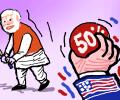
'Things may get much worse before they get better,' predicts Ajay Chhibber.

Experts say the state's economy is grappling with hidden debt, rising welfare costs, and lack of transparency.

March 31 marked 10 years since the Modi government introduced its first Foreign Trade Policy (FTP 2015-20) that lasted for 8 years before the current FTP 2023 came in. Here is a brief assessment. In 2015, the government said that it aims to increase India's exports of merchandise and services from $465.9 billion in 2013-14 to approximately $900 billion by 2019-20 and to raise India's share in world exports from 2 per cent to 3.5 per cent.

'Most tax notices arise not from wrongdoing, but from unintentional mismatch or ignorance.'

The government's move to tweak the long-term capital gains (LTCG) tax regime proposed in the Finance Bill 2024 and re-introduce the indexation benefit is likely to boost the investments and spur housing sales in the country, industry executives believe. "By enabling taxpayers to choose the lower tax burden between the new and old schemes, the amendment is poised to drive investment and enhance sales across housing segments," said Niranjan Hiranandani, chairman of the Hiranandani Group. In Budget 2024, Union Finance Minister Nirmala Sitharaman proposed an overhaul in the capital gains tax regime, including lowering the LTCG tax to 12.5 per cent from 20 per cent.
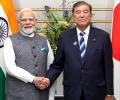
Prime Minister Shigeru Ishiba's sudden resignation after only a year in office has thrown Japan into political turmoil, raising doubts about how the country will handle economic and regional challenges, observes Dr Rajaram Panda.

Ask rediffGURU and PF and MF expert Janak Patel your mutual fund and personal finance-related questions.

The government has cut the windfall profit tax on crude oil produced in the country while the levy on exports of diesel and ATF has been hiked, an official notification said. The tax, levied in the form of special additional excise duty or SAED, on domestically produced crude oil was reduced to Rs 6,700 per tonne from Rs 7,100 a tonne. SAED on the export of diesel was increased to Rs 6 per litre from Rs 5.50 a litre and on jet fuel or ATF to Rs 4 per litre from Rs 2, the notification said.

The Comptroller and Auditor General (CAG) of India has criticized the Maharashtra state excise department for operational lapses that led to a significant revenue shortfall. The report cites incorrect fee assessments, failure to implement revised rates, and other irregularities.

To offer additional support at the low end of the income ranges, the Centre will consider a large-scale jump in exemption rates under the old income-tax regime in the vote on account, or interim Budget, according to a senior official in the know. Those will include an extension of the income tax exemption rates close to Rs 7 lakh and additional measures for women farmers.

'Geopolitically and diplomatically it's a very difficult situation for India.'

Inflows into gold exchange-traded funds (ETFs), which manage a total of Rs 37,390 crore, have surged sharply in recent months. This trend is likely to continue, especially after the reintroduction of long-term capital gains tax (LTCG), which is likely to attract smart money into mutual fund offerings amid a robust outlook for the yellow metal. Smart money, also known as opportunistic flows, refers to strategic investments that are generally of a short-term horizon.

While this will incur a revenue loss amounting to 0.2 per cent of GDP, it will provide a strong boost to consumer sentiment and spending, points out Rajani Sinha.

The news that Amazon India has launched diagnostic services in select metro cities in partnership with the unlisted Orange Health Labs has led to a look at the competitive intensity in healthcare services. Listed companies in the space such as Dr Lal Path Labs, Metropolis Health, Thyrocare, Vijaya, and Krsnaa have all seen double-digit stock price corrections over the last 6-9 months.

Leading economists advised Finance Minister P Chidambaram to rationalise taxes in the forthcoming Budget.

>According to the latest RBI data, PPF receipts have already experienced a decline between April 2023 and February 2024. Other schemes like the Sukanya Samriddhi Account and National Savings Certificate are also witnessing reduced inflows.

Several executives argue that UPI has the potential to grow tenfold, but warn that the absence of a monetisation model risks stagnating the real-time payments system, which has been recording all-time-high transaction volumes every year.

Despite the benefits of hybrid technology, a lack of government backing and few launches have kept the segment from gaining ground.
 © 2026 Rediff.com - Advertise with us - Disclaimer - Privacy Policy - Sitemap - Feedback - About us - Terms of use - Grievances